

And what might it look like?
October 16th, 2024 – British Columbia, Canada
By: The Great Canadian Bagel
We are in the final five days of the BC election and the polling has settled into an interesting pattern – the online and IVR pollsters have very different results. Now I do not mean different as in “the headline numbers are not the same” but rather that the two polling methods suggest the race is categorically different right now.
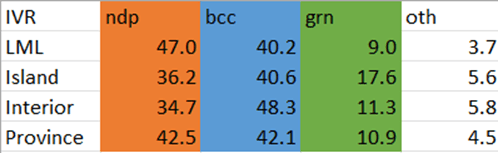
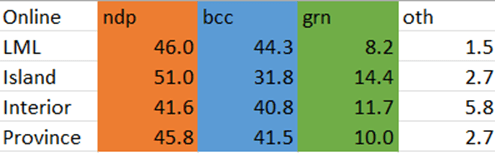
If we look just at the IVR polls we would think this race is a fairly typical race. The left wing dominates the major urban areas, the right do the same in rural and smaller urban areas, and a more niche party has very concentrated support in one particular place or riding.
The online polls seem to suggest something different – a statistical tie in the major urban areas, and with the centre-left dominating the small towns and rural areas. These two results cannot co-exist, so either this week we see the methodologies converge or we are in for a big polling miss from some or all companies.
“If this BC polling discrepancy isn’t unique to this election, while Alberta shows no difference between IVR and online polls, the question must be asked: What is happening?”
Pollsters usually are neck-and-neck and Federally these very same companies have neigh identical results right…so what could explain this discrepancy? We could consider: both methodologies have only a small headline discrepancy of 4pts and in our current Federal landscape such a small difference would be washed out on a national scale – BC is only about 13.6% of Canada’s population, so a 4pt spread only represents a 0.5pt spread nationally (well within the margin of error of any competent polling firm).
Right now, there is a similar polling discrepancy federally in BC.

So, what explains this discrepancy and why does it seem unique to BC? For example, lets take Alberta 2023, an election with a large polling miss:

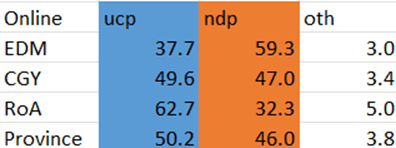
The headlines between IVR and online are virtually identical, and the regionals are well within the margin of error. Both methodologies underestimated the UCP by 2 and overestimated the NDP by 2. In the case of Alberta, most of the miss was in the rest of Alberta, precisely 65% of the error, though the UCP was underestimated in every region. I won’t break this out in this article, but this trend is very similar in ever other recent Canadian election.
If this BC polling discrepancy isn’t unique to this election, while Alberta shows no difference between IVR and online polls, the question must be asked: What is happening?
My suspicion here is that the pollsters across the province are struggling to get an appropriate sample because the BCC is a categorically different party than the BCL/BCU was. In 2020 only 54.5% of British Columbian’s voted and if the BCC is appealing more strongly to a lot of those voters, but a lot of former BCL/BCU voters are less interested and are now staying home this would cause chaos in polling. As a small-time pollster myself, to put it simply it’s very important to get an accurate picture of what the actual voter poll in a particular election is. Usually, previous elections can be used to get a picture of what that looks like, but if the pool of voters this time around is different it is very easy to be wrong.
This brings us to the question of methodologies, if we are seeing an election that is hard to predict because of the dynamics of a brand-new party why are the methodologies different? A possible explanation for this, and the one I think is most likely at the time of writing this, is that online panel polls are uniquely vulnerable to the voter pool being categorically different since former non-voters are more likely to have not signed up for the panels.
Conversely, IVR is uniquely robust to this kind of issue since it directly calls voters it ensures that it will always capture voters not previously interested in voting in elections. Does this mean that the IVR polls are more likely to be accurate? I’m leaning to yes in this instance, but I want to caution readers to not extrapolate this to a normal election, this is probably only true because of the cause surrounding the collapse of the BCU and the rise of the BCC.
So, to answer the initial question, what does this mean for polling error? Firstly, I think it will be very high in all firms, online or IVR, but the online polls will likely miss by a larger margin than the IVR polls.
*Note from the editor: To watch or learn more about the Great Canadian Bagel’s analysis, please visit their Youtube page and X Account.
 Coast & Culture
What do you think?